Arizona's extreme heat, intense UV rays, and seasonal monsoon storms can take a toll on outdoor surfaces, leaving homeowners wondering how long their paver patios, driveways, and walkways will actually last. The good news is that properly installed concrete pavers can last 25 to 50 years or longer, even in the harsh desert climate. However, their lifespan depends on several factors, including the quality of the installation, soil conditions, drainage, and ongoing maintenance. Understanding how Arizona's weather affects pavers and what you can do to protect them will help you get the most out of your investment.
Key Takeaways
Ask which published specification a concrete or clay brick paver was made to meet before you compare looks or price.
Plan for desert weather as more than a surface problem: some of it attacks the paver's face, some the ground beneath.
Judge an installer by the base they plan to build, because the ground under the pavers sets how long they stay flat.
Before replacing a tired patio, ask whether lifting and relaying only the damaged section, with the same pavers, would fix it.
What makes concrete, clay brick, natural stone and porcelain pavers last?
Each paver material lasts as long as its makeup lets it resist wear and water. For concrete and clay brick, a published standard sets that bar, so the first question to ask about any paver is which specification it was made to meet.
Concrete pavers: ASTM International's C936 specification for interlocking concrete pavers sets required physical properties such as compressive strength and absorption limits, which affect how well the units hold up.
Clay brick: brick is fired at high heat from clay or shale. ASTM's C902 specification for paving brick sorts it into durability classes based on weathering and absorption, for foot traffic and light vehicle traffic.
Natural stone: its life depends on the stone you choose. Dense stone stands up to wear better than soft, porous stone.
Porcelain: a dense, fired material that takes up little water, so a well-chosen porcelain paver resists staining and wear.
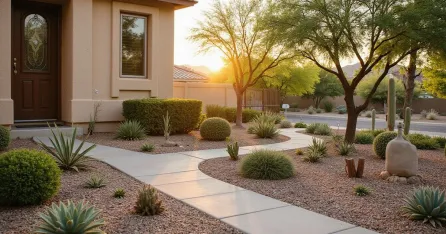
Once you have narrowed the material, these paver patio styles for an Arizona backyard show how each one looks laid out.
What wears pavers out: sun, heat, monsoon storms or shifting soil?
All four wear pavers down, but each works on a different layer. Sun and heat work on the paver's face. Storm water and soil movement go after the joints and the base underneath, which is where a patio starts to fail.
Cause | What it wears | First sign you'll see |
|---|---|---|
Sun (UV) | Surface color and any sealer | Uneven fading, dull patches |
Heat | Joint sand as it dries and loosens | Gaps opening between pavers |
Monsoon storms | Joint sand and the bedding layer | Washed-out joints, weeds |
Shifting soil | The compacted base | Dips, ruts, edges that sink |
Water you add yourself does the same harm as a storm. Overspray and poor drainage from irrigation can soak the base and wash out joints, so a well-set system protects the hardscape around it.
Why do the base and installation matter more than the paver itself?
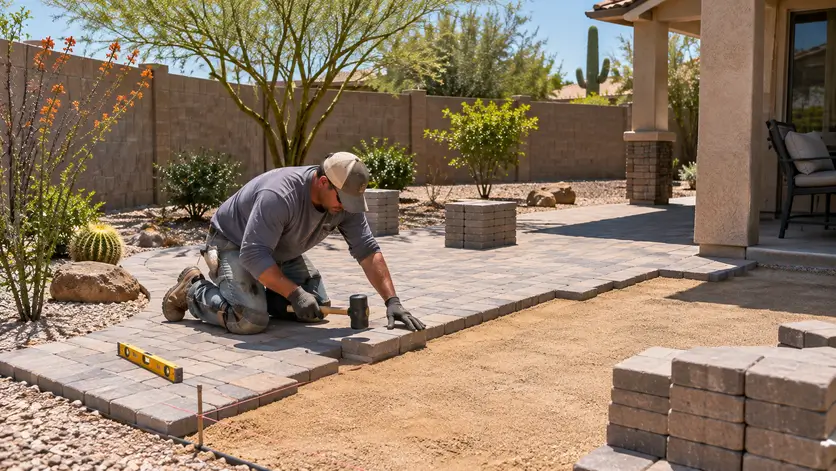
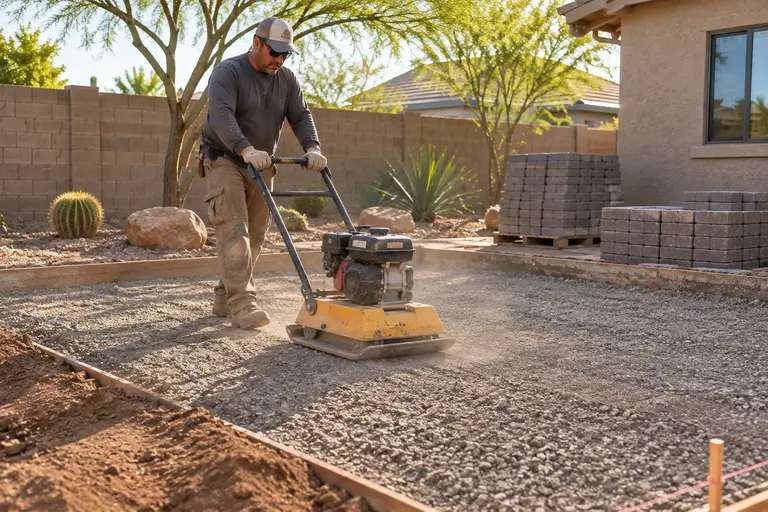
Every paver, however hard, rests on what lies beneath it. A strong unit laid on a loose or thin base will still rock and sink, while an ordinary one on a well-compacted base stays flat. Ask an installer what they dig out, what base material goes in and how it is compacted in layers. Ask, too, how the edges are held in place and which way the surface slopes, so water runs off instead of soaking down through the joints.
When do pavers need repair, and when does replacement make more sense?
Repair fits when the trouble is local: a few cracked units, one low spot by a hose bib, or joints that need fresh sand. Because pavers are separate pieces, an installer can pull up just that section and reset the same pavers on a repaired base. Replacement makes more sense when dips and rocking spread across most of the surface, since that points to a base that failed throughout. It also fits when many pavers are cracked or worn past matching. Before deciding, ask to have a few units lifted so you can see the base yourself.
How do material and design choices affect a paver project's cost and life?
Both the paver you choose and the layout drawn for it move the price; both also shape how long the surface lasts. The paver's own cost is only one line in a quote. Labor grows with the pattern. A herringbone layout or a design with curves needs more cuts than a straight running bond, though herringbone also locks units together better where cars turn. A driveway costs more to build than a patio of the same footprint because it needs a deeper base to carry vehicle weight. Site work adds to the total too, such as tearing out an old slab or carrying material into a backyard with tight side access.
Design is also where drainage gets settled. Slope, edge restraint and where roof and irrigation water will run are easier to get right on paper, which is why a paver patio often comes out of a wider landscape design plan. Ask for a few spare pavers from the same batch, so a later repair matches.
Do pavers or a poured concrete patio hold up better?
On ground that moves, pavers usually hold up better, because they are separate pieces. A poured slab is one rigid piece. When the soil under it settles or shifts, it cracks, and a patch on colored or stamped concrete rarely blends back in.
Pavers rest on a bedding layer with sand-filled joints between them. That lets the surface flex, so the same movement shows up as a shallow dip rather than a break across the patio.
The slab has its own advantage. It has no sand joints for monsoon runoff to wash out and none to refill. If your yard drains well and the soil has stayed put, a slab's lower upkeep can outweigh the pavers' flexibility.
How do you keep a paver patio or driveway in shape?
Upkeep on pavers comes down to keeping the joints full and the surface clean, so water runs off instead of working down into the base. A few habits cover it:
Sweep often. Leaves and grit ground into the joints hold moisture and give weed seeds a place to start.
Check the joints after monsoon season. Where sand has dropped below the paver edges, sweep in fresh joint sand so the units stay locked together.
Pull weeds while they are small, before their roots pry the joints apart.
Wash with a garden hose and a stiff brush. A pressure washer held close to the surface blasts sand out of the joints.
Clean oil and rust spots on a driveway soon. The longer they sit, the deeper they soak in.
Reseal a sealed surface on the schedule the sealer's maker gives.
We do not offer landscape maintenance, so this routine is yours to keep up. Our paver installation work is where the base and slope that keep that routine light get built in. To talk through a patio or driveway, contact Surprise AZ Landscaping or call 623-292-2472.
Sources
C936/C936M Standard Specification for Solid Concrete Interlocking Paving Units, ASTM International, retrieved 2026-10-30.
C902 Standard Specification for Pedestrian and Light Traffic Paving Brick, ASTM International, retrieved 2026-10-30.

Written by
Content Writer & Editor, RAD SEO
Michele M. Simpson writes and edits the landscaping guides on this site. She is the content writer and editor at RAD SEO, and she spent several years working in the office of a landscaping company, an inside view of how projects come together that she brings to every article. Her focus is clear, practical advice for Arizona homeowners planning their outdoor spaces.